Sunday, March 25, 2012

Why Bilinguals Are Smarter


SPEAKING two languages rather than just one has obvious practical benefits in an increasingly globalized world. But in recent years, scientists have begun to show that the advantages of bilingualism are even more fundamental than being able to converse with a wider range of people. Being bilingual, it turns out, makes you smarter. It can have a profound effect on your brain, improving cognitive skills not related to language and even shielding against dementia in old age.

This view of bilingualism is remarkably different from the understanding of bilingualism through much of the 20th century. Researchers, educators and policy makers long considered a second language to be an interference, cognitively speaking, that hindered a child’s academic and intellectual development.

They were not wrong about the interference: there is ample evidence that in a bilingual’s brain both language systems are active even when he is using only one language, thus creating situations in which one system obstructs the other. But this interference, researchers are finding out, isn’t so much a handicap as a blessing in disguise. It forces the brain to resolve internal conflict, giving the mind a workout that strengthens its cognitive muscles.

Bilinguals, for instance, seem to be more adept than monolinguals at solving certain kinds of mental puzzles. In a 2004 study by the psychologists Ellen Bialystok and Michelle Martin-Rhee, bilingual and monolingual preschoolers were asked to sort blue circles and red squares presented on a computer screen into two digital bins — one marked with a blue square and the other marked with a red circle.

In the first task, the children had to sort the shapes by color, placing blue circles in the bin marked with the blue square and red squares in the bin marked with the red circle. Both groups did this with comparable ease. Next, the children were asked to sort by shape, which was more challenging because it required placing the images in a bin marked with a conflicting color. The bilinguals were quicker at performing this task.

The collective evidence from a number of such studies suggests that the bilingual experience improves the brain’s so-called executive function — a command system that directs the attention processes that we use for planning, solving problems and performing various other mentally demanding tasks. These processes include ignoring distractions to stay focused, switching attention willfully from one thing to another and holding information in mind — like remembering a sequence of directions while driving.

Why does the tussle between two simultaneously active language systems improve these aspects of cognition? Until recently, researchers thought the bilingual advantage stemmed primarily from an ability for inhibition that was honed by the exercise of suppressing one language system: this suppression, it was thought, would help train the bilingual mind to ignore distractions in other contexts. But that explanation increasingly appears to be inadequate, since studies have shown that bilinguals perform better than monolinguals even at tasks that do not require inhibition, like threading a line through an ascending series of numbers scattered randomly on a page.

The key difference between bilinguals and monolinguals may be more basic: a heightened ability to monitor the environment. “Bilinguals have to switch languages quite often — you may talk to your father in one language and to your mother in another language,” says Albert Costa, a researcher at the University of Pompeu Fabra in Spain. “It requires keeping track of changes around you in the same way that we monitor our surroundings when driving.” In a study comparing German-Italian bilinguals with Italian monolinguals on monitoring tasks, Mr. Costa and his colleagues found that the bilingual subjects not only performed better, but they also did so with less activity in parts of the brain involved in monitoring, indicating that they were more efficient at it.

The bilingual experience appears to influence the brain from infancy to old age (and there is reason to believe that it may also apply to those who learn a second language later in life).

In a 2009 study led by Agnes Kovacs of the International School for Advanced Studies in Trieste, Italy, 7-month-old babies exposed to two languages from birth were compared with peers raised with one language. In an initial set of trials, the infants were presented with an audio cue and then shown a puppet on one side of a screen. Both infant groups learned to look at that side of the screen in anticipation of the puppet. But in a later set of trials, when the puppet began appearing on the opposite side of the screen, the babies exposed to a bilingual environment quickly learned to switch their anticipatory gaze in the new direction while the other babies did not.

Bilingualism’s effects also extend into the twilight years. In a recent study of 44 elderly Spanish-English bilinguals, scientists led by the neuropsychologist Tamar Gollan of the University of California, San Diego, found that individuals with a higher degree of bilingualism — measured through a comparative evaluation of proficiency in each language — were more resistant than others to the onset of dementia and other symptoms of Alzheimer’s disease: the higher the degree of bilingualism, the later the age of onset.

Nobody ever doubted the power of language. But who would have imagined that the words we hear and the sentences we speak might be leaving such a deep imprint?

Saturday, March 17, 2012

Colombia’s oil industry-- Gushers and guns


IT HAS attracted much less attention than the big deep-sea oil finds in Brazil, but Colombia is also enjoying an oil boom. Its output of crude has nearly doubled in the past six years, from 525,000 b/d in 2005 to a daily average of 914,000 last year. But as exploration pushes deep into the country’s eastern lowlands, oil companies face a familiar problem in rural Colombia: security.

Emerald Energy, a British subsidiary of China’s Sinochem, has endured repeated attacks by the FARC guerrillas on its small Ombú field in Caquetá. Security officials in the area say the FARC is demanding $10 for each barrel of oil. Because the company refused to pay, three of Emerald’s Chinese staff, together with their translator, were kidnapped last June. After a bomb attack on a well, Emerald announced on March 6th that it would suspend operations “until security conditions improve”. After receiving assurances from military commanders, production resumed the next day, but six days later oil tankers carrying crude from Ombú came under guerrilla fire, leaving two civilians dead.


Although Colombia is generally a much safer country than it was a decade or more ago, attacks on oil infrastructure more than doubled between 2008 and 2011, according to the Centre for Security and Democracy at Bogotá’s Sergio Arboleda University. In January and February there were 13 separate attacks on the country’s main pipeline, from Caño Limón to Coveñas, which was able to pump oil for only 20 days in that period. The trans-Andean pipeline in the south was attacked 51 times last year. In February the ELN, a smaller guerrilla group, kidnapped 11 men in Casanare who were building the Bicentenario, a big new pipeline. Officials say that guerrillas are behind some disruptive protests by local people in oil areas, demanding more money and jobs.

The spike in violence “has us worried”, says Alejandro Martínez, president of the Colombian Petroleum Association, which groups together private oil companies operating in the country. But he adds that the industry’s security problems are in part a consequence of its own success. It offers a much bigger target nowadays.

Several things lie behind the oil boom. To attract investment, the governments of Álvaro Uribe, Colombia’s president from 2002 to 2010, licensed large areas of the country for exploration and offered tax breaks. Private firms were no longer required to form partnerships with Ecopetrol, the state oil company. And the government sold shares in Ecopetrol, allowing it to increase its capital spending fourfold since 2007. At the same time, Colombia benefited from the improvement in security, and the hostility of Venezuela, Ecuador, Bolivia and Argentina to foreign investors.

In all, foreign direct investment in the oil industry jumped from $278m in 2003 to $4.3 billion in 2011, according to the central bank. Many of the new investors are start-ups, listed in Canada but run by technicians sacked from PDVSA, Venezuela’s state oil company, by Hugo Chávez after a strike in 2003. Though some new fields are in Caquetá and Putumayo, where few foreign firms dared venture before, most of the extra output comes from using new technology to increase recovery at old wells. Production at the Rubiales field, discovered in 1981, has risen from 8,000 b/d in 2007 to 165,000 last year.

The spate of attacks on oil installations, however, meant that output fell short of the government’s forecast of 1m b/d by the end of last year. Reaching the target of 1.5m b/d by 2015 will require continuing pressure on the guerrillas.

The violence is in part a reaction to a reform of royalties by Juan Manuel Santos, Mr Uribe’s successor. Most used to go to mayors in oil areas, and were often stolen by guerrillas or paramilitaries. Royalties now go to the central government, which hands them out according to stricter criteria. So the gunmen have switched to extorting from oil companies rather than mayors. That, too, looks like a problem of success—but one that needs to be fixed.

Tuesday, February 28, 2012

Draft dodgers no more - Can the Dominican Republic avoid Puerto Rico’s fate?

http://www.economist.com/node/21546064

Baseball in Latin America

Draft dodgers no more

Can the Dominican Republic avoid Puerto Rico’s fate?


Try a cricket bat instead SEEN from the air, much of Puerto Rico’s northern coast is a mosaic of rooftops and treetops dotted with countless baseball diamonds. The island of 4m has sent a total of 234 players to America’s Major League Baseball (MLB)—twice as many as Mexico. Its Baseball Hall of Fame, just outside San Juan, features a salon full of life-size statues of Puerto Rico’s athletic pantheon. It even includes a famous broadcaster seated at his microphone.

Today, however, the fields are mostly used for football. Just 2.6% of MLB players are Puerto Rican, down from 4.3% in 2001. The island’s renowned winter baseball league cancelled its season in 2007. A typical game now draws fewer spectators than nearby women’s volleyball matches. Its four teams are on the block for around $750,000 each. No one is buying. Several factors account for this decline. They include better job opportunities outside sports and competition from basketball, reggaetón music, multiplexes and malls. But the biggest was MLB’s inclusion of the island in its amateur draft in 1990.

Every year, MLB teams select 1,500 players from schools and universities. The clubs get to pick in reverse order of their finish in the league the previous season. Draftees can negotiate only with the team that chooses them. Officially, the draft is meant to help the worst teams by giving them the best young talent. But all clubs love it because it reduces signing bonuses.

When the draft began in 1965, only Americans were eligible. But 25 years later MLB extended it to Canada and Puerto Rico. In theory, this should not have affected the number of Puerto Ricans signed, since undrafted players become free agents, who can sign with any team they wish. But in practice, MLB clubs rarely sign them; they tell them to go to university and try their luck in the draft later on. The draft thus forced Puerto Ricans to compete with Americans for a fixed number of places.


Moreover, whereas Puerto Ricans could previously be signed at age 16, a high-school degree (usually given at 18) is required for the draft. Since the island’s schools do not have baseball teams, its 16- and 17-year-olds had nowhere to train. As a result, the number of Puerto Rican MLB signings fell by 13% in 1991-92. Meanwhile, players from the Dominican Republic (DR) and Venezuela remained free agents. Their numbers soared (see chart).

Now those countries may be facing Puerto Rico’s fate. As more clubs started to recruit in Latin America, signing bonuses took off: the average payout in the DR rose from $29,000 in 2004 to $108,000 in 2008. In response, teams tried to cut costs. In November MLB’s teams and its players’ union reached a deal that levies a tax on clubs whose spending on foreign free agents exceeds a cap. It also sets up a committee to institute an international draft by 2014.

In the DR, MLB’s biggest source of foreign players, the reaction has been apoplectic. Baseball is big business there: MLB’s direct value to the economy is $125m-150m a year (0.3% of GDP). Its 30 clubs all have training academies for their players, mainly in poor rural areas. They employ 1,200 people, many in new professions like groundskeeper and sports nutritionist. And in response to criticism that they exploit youngsters, they are offering better education. The Pittsburgh Pirates require four hours of class a day, and last year granted 13 high-school degrees.

The indirect benefits are bigger still. An estimated 2,000-3,000 scouts and trainers, called buscones, scour the country for players and house, feed and instruct them until they sign an MLB contract. They charge 30% of the bonus. Some buscones employ dozens of workers. The winter league plays nearly 200 games a year, each drawing thousands of fans. Casa de Campo, a golf resort, now has a Latino Baseball Hall of Fame. Many players also have charities: Pedro Martínez, a star pitcher, has built a youth centre offering art, cooking and computer classes to 300 students. A draft could put all this in peril, by reducing bonuses and possibly the number of contracts.

Rafael Pérez, MLB’s director of Dominican operations, insists that MLB wants at least to maintain the current number of foreign signings. But many buscones accuse MLB of selling out Latinos to protect American players’ jobs. They note there is just one Latino on MLB’s international-talent committee—who, as the son of an MLB player, mostly grew up in America. “I feel like we’re being invaded, like it’s 1965 all over again,” says Astin Jacobo, a buscón, referring to America’s occupation of the DR. “We’re only number one in one thing, and that’s baseball. We can’t give that away.”

A group of Dominican buscones has already held anti-draft protests. They might convince MLB to set up a separate draft for foreigners with an eligibility age of 16, which would be less disruptive than extending America’s draft abroad. But stopping the draft entirely will be hard.Many buscones talk of a strike. But they have not formed a union. Even if they do, they could not stop their players from opting to sign with MLB teams.That leaves the government. Felipe Payano, the sports minister, has already written a letter to Bud Selig, MLB’s commissioner, expressing his opposition to a draft. He says his office is investigating whether it might violate the DR’s free-trade agreement with America. Another option would be to sue MLB for collusion under Dominican antitrust law. But it would take a lot of pluck for a small, poor, baseball-dependent country to pick a fight like that.

Monday, February 20, 2012

Corruption in Argentine football -- Foul play

http://www.economist.com/blogs/gametheory/2012/02/corruption-argentine-football/print

Feb 18th 2012, 14:23 by D.S. | BUENOS AIRES

RENOWNED worldwide for their sublime skills, Argentina’s footballers are a source of great pride to their countrymen. Yet few law-abiding Argentines hold their football league in similar high regard. Many of those involved in it are tainted by corruption, from club presidents down to security guards at matches. Money laundering in the system is thought to be rife. In a long-overdue effort to clean up the game, the government this month introduced new financial-disclosure requirements for the league and its teams. But these still pale in comparison with the scale of the problem.
Argentina has been under pressure to combat corruption since last June, when the Financial Action Task Force (FATF), an international body set up to fight money laundering, placed it on a “grey list” of countries whose efforts to root out wrongdoing do not measure up. Although the FATF did not single out football, it had expressed its concerns about money laundering in the game in a report published in July 2009, which made reference to Argentina. Inclusion on the grey list carries an implicit warning that a country risks ending up on the FATF’s notorious “black list” unless it makes progress. Countries in that category have, in the past, found it extremely difficult to do business with any of the FATF’s 34 members, which include big economies like America, Britain and France, as well as Mexico, another Latin American heavyweight.
Largely in response to the FATF’s criticisms, the government this month forced the Argentine Football Association, the sport’s national governing body, to adopt a new set of rules. For a start, it must file an annual report on every member of staff paid at least $13,800 a year (including bonuses, prizes and gifts), as must every club in the top two divisions of the league. They also have to provide details of payments they make to corporate sponsors, government officials and anybody else with whom they do business. Failure to disclose this information can result in a fine of up to $23,000. And if reports uncover evidence of illegal payments, the fine can be as much as ten times the sum involved. Unless the Argentine Football Association strictly enforces the new rules, the government says it will withdraw the $200m it provides each year so that football fans can enjoy televised matches free of charge.
None of this is likely to be sufficient to stop the rot. Corruption has flourished due largely to the activities of the so-called barrabravas, violent groups of fans with interests in organised crime. The story of their rise dates back to the 1950s, when officials started trading free tickets for fans’ votes, which they needed to win election to a club’s board. As these fans grew more powerful and demanding, they began to take illicit control of club affairs like ticketing and the sale of refreshments during matches. Today, club directors often owe their positions entirely to barrabravas. Footballers are also under their control, sometimes splitting wages with them. Players from Boca Juniors, Argentina’s most popular club, even visited Rafael Di Zeo (pictured), the former boss of the team’s barrabrava, when he was in jail (he was released in May 2010 after serving more than three years for assault).
Barrabravas have already taken some blame for the decline of several big clubs in recent years. The most notable case is that of River Plate, one of the oldest teams in Latin America, which was relegated to the second division last year for the first time in its 110-year history. Its demotion followed years of mismanagement and corruption—exacerbated by infighting between members of the club’s own barrabrava—that left it saddled with huge debts, forcing it to sell its most gifted players to wealthy European clubs.
The new rules are certainly a step in the right direction for Argentina. Besides making it harder for miscreants to launder money with impunity, the government has given the Argentine Football Association an incentive to police the system effectively by threatening to withdraw its funding of television coverage. But having shown scant regard for existing laws and regulations, the barrabravas seem unlikely to pay much heed to new rules on financial disclosure. If Argentina’s government is serious about ending the corruption, it will need to confront the gangs on the terraces and in the streets. That is an altogether tougher prospect.

Monday, February 13, 2012

Women in Mexican politics. The XX factor -- Can a woman candidate count on female voters’ support?

http://www.economist.com/node/21547282

UNTIL this year, no woman had ever been the presidential candidate for any of Mexico’s main political parties. That changed on February 5th, when Josefina Vázquez Mota, a former secretary of education and of social development, won the primary of the conservative National Action Party (PAN). “I will be Mexico’s first presidenta” (female president), she said in her victory speech.

Ms Vázquez is a clear underdog in the July 1st election. Polls taken before the primary put the centrist Institutional Revolutionary Party (PRI) nearly 20 points ahead of the ruling PAN (see chart). Voters have tired of the PAN, which has presided over slow growth and rising violence during 11 years in power. Ms Vázquez could even finish third behind Andrés Manuel López Obrador of the Party of the Democratic Revolution, a left-winger who narrowly lost the 2006 race.
No one knows if Mexico’s supposedly macho voters are open to a female candidate. Women only gained the right to vote in 1953. But Mexican politics is not especially male-dominated: women hold over a quarter of congressional seats. That is a higher proportion than America’s and twice as high as the share in Brazil, which elected a female president in 2010.
Ms Vázquez has said she considers her sex an advantage. It certainly helps to distinguish her from Felipe Calderón, the unpopular current president and a fellow PAN member. According to Mitofsky, a polling firm, women outnumber men by a fifth among her supporters.
Meanwhile, her rivals’ attempts to woo female voters have not gone well. The PRI’s handsome Enrique Peña Nieto, whose rallies draw throngs of swooning señoritas, was thought to have an edge with them. But when he was recently asked if he knew the price of meat and tortillas, he replied that he was not “the lady of the house”. A few weeks later an ex-girlfriend accused him of neglecting children he fathered outside marriage. The fiery Mr López has tried to soften his image by promising a “loving republic”. But women seem unmoved. A majority of both candidates’ fans are male.
Women have always been less likely to vote than men in Mexico. Might that change this year? The gender gap has disappeared in school-attendance and literacy rates. A third of women work outside the home, helped by a fall in the fertility rate from nearly seven children per woman in the 1960s to around two today. But younger Mexicans of both sexes are less likely to vote than others; and Ms Vázquez’s opposition to abortion may not appeal to the new generation of empowered women. She clearly needs their support to close the gap.

Sunday, February 5, 2012

What does "Latin Music" mean to you?


What does "Latin Music" mean to you?
It what way is it representative of the culture?
It what way isn't it?
Do you have a favorite Latin music video?
Include the link in your comment.

Sunday, January 29, 2012

The Discontents of Progress

 <a href="http://www.economist.com/node/21534798"></a>

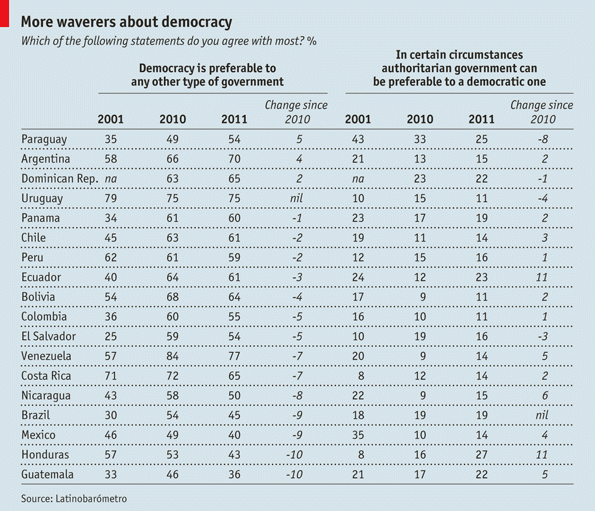
LATIN Americans are demanding more of their democracies, their institutions and governments; they worry about crime almost as much as about economic problems; and fewer of them think that their country is progressing. Those are some of the findings of the latest Latinobarómetro poll, taken in 18 countries and published exclusively by The Economist. Because the poll has been taken regularly since 1995, it does a good job showing how attitudes in the region are changing.


Despite Latin America’s strong recovery from the recession of 2008-09, this year’s poll, which was taken in July and August, reveals some diffuse discontents. It suggests that little over half of Latin Americans are convinced democrats, a fall of three points since last year (see table and chart 1). Guatemala, Honduras and Mexico all saw a sharp slump in support for democracy, probably because of high levels of violent crime in all those countries. Only 45% of Brazilian respondents were convinced democrats, a nine-point fall from last year: it is harder to pinpoint why, except perhaps that Dilma Rousseff, the new president has taken a tough line on corruption, thus drawing more attention to it.


Only 39% of respondents across the region said they were satisfied with the way their country’s democracy works in practice—a fall of five points compared with last year. Argentines were much more satisfied than in 2010—which helps to explain why Cristina Fernández easily won a second term in a presidential election this month. Chile leads several countries where disgruntlement is rising: only 32% of Chilean respondents were satisfied with the operation of their democracy, down from 56% last year (see chart 2).


That doubtless reflects months of protests over the high price of education in Chile (see article). The quality of public services is becoming an increasingly important issue across the region, especially for what is dubbed the “new middle class”. “There’s a feeling among those who have left poverty that it’s much more difficult to carry on rising,” says Marta Lagos, Latinobarómetro’s director. “They want to compete on equal terms with the rich.”

Some Latin Americans feel that their governments are not giving them value for money: 96% of respondents in Brazil thought that taxes were “high” or “very high”, while only 13% think that they will be well spent. A clear majority continue to believe in the market economy. Such attitudes ought to provide an opportunity for politicians of the centre-right in a region that has voted for many leftish governments over the past decade. But against that, only 20% of respondents think that the distribution of income in their country is fair. (That number rises to 43% in Ecuador, which helps to explain the popularity of its populist president, Rafael Correa.)

This more demanding attitude is also reflected in falls in the number of respondents who think their country is making progress (see chart 3). These declines are particularly pronounced in Chile and Brazil, two countries where the “new middle class” is numerous, but also in the Dominican Republic and Costa Rica, whose economies have grown strongly in recent years. This year’s poll also reveals a slight fall in confidence in the region’s institutions of all kinds (see chart 4). In the case of governments (in which 40% of respondents expressed confidence, down from 45% in 2010), this follows several years in which public trust has risen. Confidence in the Catholic church among respondents in Chile has plummeted to just 38%, from 62% last year, following a paedophilia scandal.

This year’s more disgruntled mood is striking because public concern about unemployment and economic problems has returned to its pre-crisis level (see chart 5). But Latin Americans worry more about crime: 28% of respondents (and 61% in Venezuela) say this is the main problem in their country. Brazilians worry most about their health system, Chileans about education. In this, they may be trendsetters.


Latinobarómetro is a non-profit organisation based in Santiago, Chile, which has carried out regular surveys of opinions, attitudes and values in Latin America since 1995. The poll was taken by local opinion-research companies in 18 countries and involved 20,204 face-to-face interviews conducted between July 15th and August 16th 2011. The average margin of error is around 3%. Full details here